Article | 23 October 2026
Environmental DNA: from sample to decision-making
A fish can remain hidden beneath the surface, and a fungus can grow without any visible structure. Their DNA can still be found in a water or soil sample. Environmental DNA (eDNA) turns these traces into data about the organisms detected, which can be traced and compared over time when suitable protocols are used.
For businesses, local authorities and site managers, eDNA provides an objective way to establish a baseline, monitor the effects of restoration, or develop monitoring indicators. These indicators can then support action planning and CSRD/TNFD reporting.
What eDNA brings to a decision
Biodiversity is becoming a governance issue. Beyond good intentions, measurable and comparable data are needed to support sustainability reporting. eDNA addresses four practical needs:
- Establishing a reliable baseline before a project, acquisition or development.
- Detecting species of concern, including protected or invasive species and those that are elusive or rare, without capturing or disturbing them.
- Monitoring a site over time and tracking the effects of restoration or compensation measures.
- Providing defensible data for a client, funder, auditor or authority: documented protocols, sample traceability and checked genetic reference data.
What is environmental DNA?
Every living organism leaves genetic traces in its environment: cells, mucus, faeces and tissue fragments. eDNA analysis recovers these traces from a water or soil sample, then analyses them in the laboratory to detect and identify organisms whose DNA is present.
The laboratory compares the detected DNA fragments with reference sequences. This makes it possible to assign an identity, down to species level when the references allow. The result is an inventory of organisms detected at the site under the conditions of the study.
Water and soil: two sources, two perspectives
Water: detecting hidden biodiversity
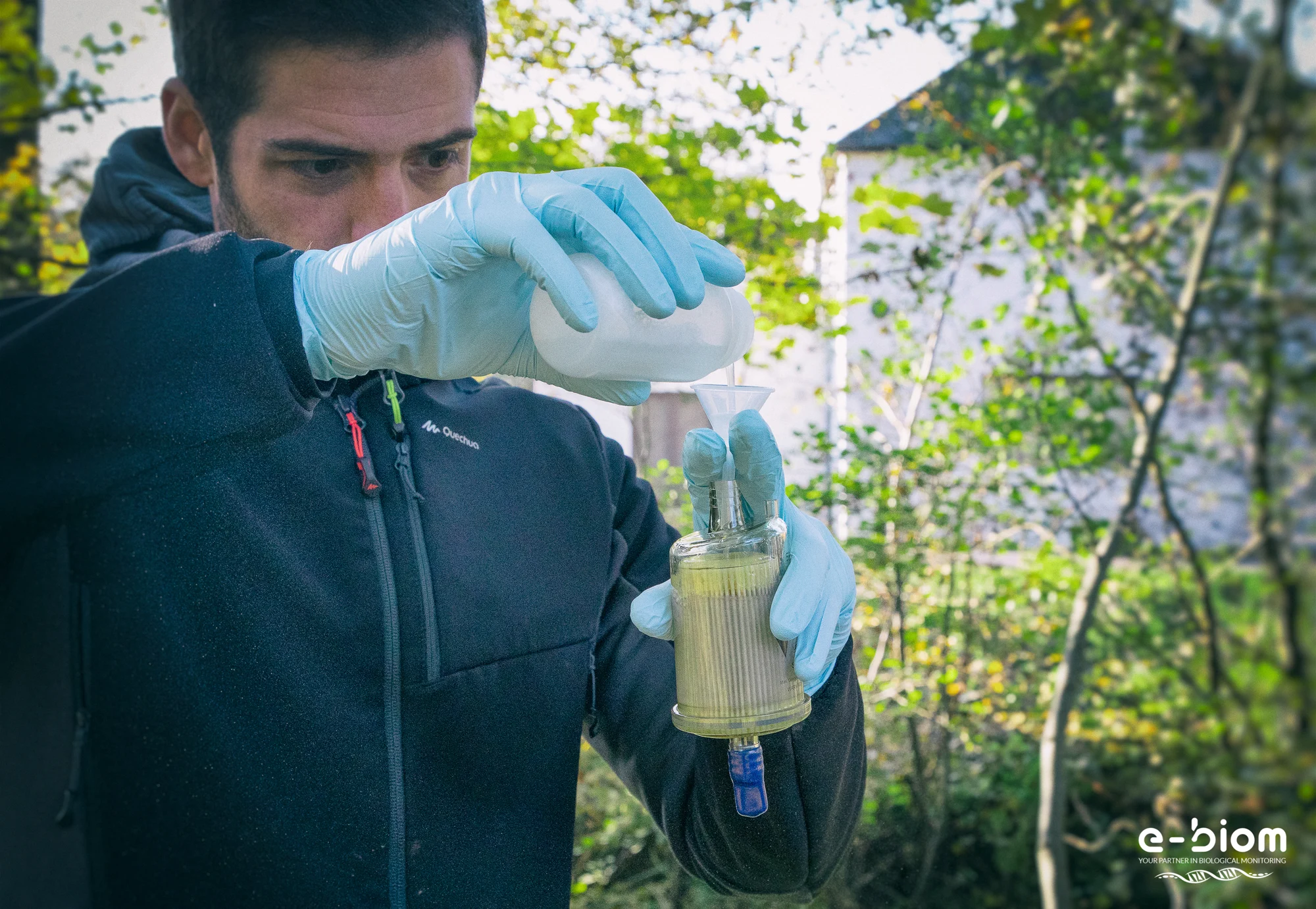
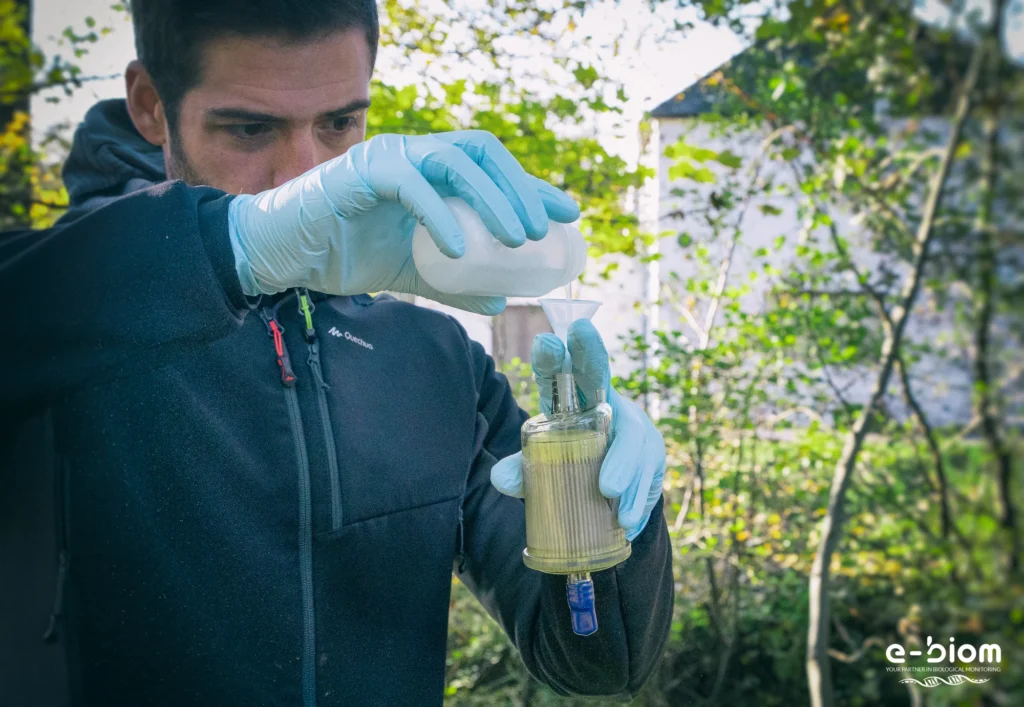
A water sample, filtered to concentrate biological material, can be used to look for fish, amphibians, some invertebrates and microorganisms. In a watercourse, transported DNA can also provide information about upstream conditions. A sampling point therefore documents an area wider than its exact location. This is useful for exploring a catchment, but must be considered when interpreting results.
Soil: exploring what observation cannot reveal
Soil hosts communities of bacteria, fungi, protists (microscopic single-celled organisms) and invertebrates that contribute directly to its fertility and resilience. Because soil is heterogeneous, the sampling plan is designed around the site's different areas, such as agricultural plots, brownfield land, disturbed ground and woodland edges, to make the analysis representative.
From sample to inventory: the integrated eDNA workflow
- Define the question before choosing the method. Establishing a baseline, searching for an invasive species and monitoring restoration are different objectives. They require different sampling plans and analyses.
- Design a sampling plan suited to the site. Locations, periods, replicates, preservation and sample traceability are defined in advance. This helps make results reliable and comparable between sampling campaigns.
- Extract and amplify the DNA. DNA is isolated from the filter or soil, then amplified by PCR, a technique that produces millions of copies so it can be analysed.
- Choose the analytical approach. Barcoding and metabarcoding analyse a genetic marker: a short DNA sequence used as an identification signature. Targeted analysis searches for the DNA of a particular species, while metabarcoding analyses genetic markers to identify multiple organisms in one sample. Barcoding is used, among other applications, to identify an organism from its DNA sequence.
- Identify the organisms. After DNA sequencing, our bioinformaticians compare the sequences with international reference databases.
- Interpret the findings with ecologists. The species list is considered alongside habitats, pressures and site-specific issues, turning it into information that can support decisions.
Practical example: a biodiversity baseline for an industrial group
This workflow becomes meaningful when it answers a practical management question. Here is how it can be used across several industrial sites.
The context. A group operating several industrial sites is preparing its sustainability reporting and documenting biodiversity around its sites for the first time. Its teams have neither baseline data nor a shared method across sites.
The approach. E-BIOM defines a common methodological framework: water sampling in nearby aquatic environments, soil sampling in representative areas, laboratory metabarcoding analysis, and interpretation by ecologists in relation to the issues at each site.
The result. Five sites, eight water samples and fourteen soil samples, with seven groups of organisms documented. The group obtains a baseline that can be compared between sites, a map of priority issues and a foundation for measuring the effects of its actions in subsequent years.
The decision. The results help prioritise sites, develop an action plan and select monitoring indicators suited to the group's objectives. Repeated using a comparable protocol, the analysis can then help document changes in biodiversity and the effects of the measures implemented.

Interpreting eDNA results: three safeguards in every study
An eDNA result is scientific data and must be interpreted systematically. We incorporate three safeguards into each study:
- A sampling plan suited to the site, to improve representativeness and interpret results, including non-detections, within their limitations.
- Checked genetic reference data, to support reliable identification down to species level where possible.
- Ecological interpretation, because a detection alone does not indicate how many individuals are present. Site conditions, including water flow, DNA persistence and habitats, help explain the signal.
These safeguards distinguish a species list from data that a management committee, client or auditor can use with confidence.
The E-BIOM approach: from eDNA to strategy
E-BIOM combines a 240 m² genetics laboratory dedicated entirely to environmental genetic analyses with a consultancy. One team handles the complete workflow:
- Protocol and sampling design.
- Laboratory analyses and bioinformatics.
- Interpretation by ecologists.
- Decision-focused reporting: an actionable summary for management committees or boards, supporting action planning and CSRD and TNFD reporting processes.
We work with businesses, site managers and organisations involved in water, agronomy and research, among others.
Frequently asked questions
How long does an eDNA study take?
This depends on the number of sites, the sampling season and the level of analysis. Initial scoping establishes a precise schedule suited to your reporting or project deadlines.
What do you receive at the end of a study?
Depending on your needs, you receive data, a species list or a structured report covering methodology, analytical results, ecological interpretation and recommendations, providing material for your reporting.
Can one sample inventory all biodiversity?
No. A sample represents part of the environment, and each analysis targets particular groups of organisms. The sampling plan and choice of markers are therefore defined around your objectives.
Is eDNA a non-invasive method?
eDNA sampling generally makes it possible to look for species without capturing or directly handling them. This limits disturbance associated with observation and can be particularly useful at sensitive sites. The sampling impact on the environment nevertheless depends on the protocol used.
Should you sample water or soil?
That depends on the organisms being investigated and the nature of the site. Where a site includes both aquatic and terrestrial environments, the two are often complementary.
Can results be compared from one year to the next?
Yes, if monitoring is designed for this purpose: the same protocol, comparable seasons and a consistent method. This is the basis of restoration monitoring or recurring reporting.
Can eDNA be used in CSRD or TNFD reporting?
eDNA is an established scientific method for measuring biodiversity. With an appropriate protocol, it can generate traceable, comparable data from which indicators can be developed for CSRD and TNFD reporting processes. How these are incorporated depends on your objectives, the protocol and the reporting framework. We define this with you from the outset.
How do E-BIOM's eDNA analyses contribute to global biodiversity funding?
Working with E-BIOM means participating in a pioneering regenerative finance model. To mark COP17, we became the third company to contribute to the Cali Fund, and chose to go further by making this contribution part of our business model. Following an initial contribution in 2026, from 2027 we commit to contributing 0.1% of the value of each of our eDNA services every year. A one-off payment would have been possible; we chose a lasting commitment to support the restoration of nature.
What does the Cali Fund mean for a business assessing its biodiversity impact?
Established under the UN Convention on Biological Diversity (CBD), the Cali Fund supports the fair and equitable sharing of benefits from the use of digital sequence information on genetic resources (DSI), meaning DNA data derived from living organisms. For business leaders and sustainability managers, choosing E-BIOM's eDNA services offers both a breakthrough technology for CSRD or TNFD reporting and an approach praised by CBD Executive Secretary Astrid Schomaker as an example of how businesses that depend on nature can give back to it.
From sample to decision-making
Are you preparing a biodiversity baseline, TNFD/CSRD reporting or site monitoring? Our teams design the protocol, analyse samples in our laboratory and provide interpretation you can use in your decisions.